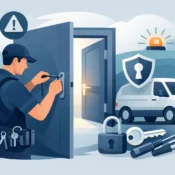

How to Secure Home After Burglary Fast

How to Secure Home After Burglary Fast
The worst part after a burglary is often the moment you realise the property still is not secure. A damaged lock, a forced door or a window that no longer shuts properly can leave you feeling exposed long after the intruder has gone. If you are searching for how to secure home after burglary, the priority is simple - make the property safe again first, then improve it so it is harder to target next time.
How to secure home after burglary: first steps
Start with safety, not repairs. If you believe the burglar could still be nearby, stay outside and call the police. If the police have already attended and the property has been checked, take a quick look at the main access points without touching more than necessary. You need to know whether the front door, back door, patio doors or ground-floor windows can still be locked.
If a lock has been snapped, the cylinder pulled out, the handle broken or the frame split, do not assume the door is secure just because it closes. A door that shuts but does not lock properly is still vulnerable. The same goes for windows with bent handles, cracked hinges or damaged locking points.
This is where speed matters. Temporary security is sometimes enough for the first night, but only if it genuinely prevents access. In many cases, the safest move is to get a local locksmith out straight away to assess the damage, secure the entry point and replace failed parts before the property is left unattended again.
Check what was actually compromised
After a break-in, people often focus on the obvious damage and miss weaker points elsewhere. A burglar may have forced one door, but also tested another lock, loosened a window handle or damaged a frame enough to make future entry easier.
Walk through the property methodically. Check external doors, window locks, garage side doors, rear gates and any access from a conservatory or extension. Pay close attention to uPVC doors, where the handle or euro cylinder might show the main damage while the internal mechanism has also been affected. If the key turns badly, the handle feels loose or the door no longer lines up with the frame, that needs attention.
There is a trade-off here. You can do a visual check yourself, but hidden lock damage is easy to miss. If you want certainty, a professional inspection is worth it, particularly after forced entry.
Secure the damaged door or window properly
The right repair depends on how entry was gained. If the burglar attacked the lock, replacing the lock may be enough. If they damaged the keep, handle, gearbox, hinges or frame, changing one part alone will not solve the problem.
For timber doors, the strike plate and surrounding wood often need reinforcement, not just a new lock. For uPVC and composite doors, the failure may be in the multi-point mechanism, handle set or cylinder. For windows, a broken handle can be straightforward, but a bent sash, failed espagnolette or cracked frame may need more than a quick fix.
A temporary boarding solution can help if glass is broken, but it should be treated as temporary. If the property is going to be occupied, or if you need to leave it empty for any period, proper locking security should be restored as soon as possible.
If you need urgent help in Crawley or nearby, SaveMeLocksmith can attend to secure doors, change locks, repair damage and advise on what actually needs upgrading rather than replacing for the sake of it.
Change locks after a burglary if there is any doubt
One of the most common questions is whether locks must always be changed. Not always, but often. If keys were taken, if the lock was manipulated rather than forced, or if you cannot be sure who now has access, replacing the lock is usually the safest option.
Even where the old lock still works, it may no longer meet a reasonable security standard. A basic euro cylinder that has already been snapped or bypassed should not go back on the door. Upgrading to an anti-snap, anti-pick and anti-drill cylinder is a practical improvement, not a sales extra.
The same applies to older night latches and worn mortice locks. If the hardware is outdated, loose or easy to force, this is the time to replace it. You have already seen where the weak point is.
Improve security without turning the house into a fortress
Once the urgent repairs are done, think about how the burglary happened. Was it a weak front door cylinder, a rear window left vulnerable, poor lighting, or easy access through a side gate? Good security is rarely about one expensive product. It is usually about fixing the obvious weaknesses in the right order.
Start with the main entry points. Doors should shut squarely, lock cleanly and have hardware suited to the door type. Ground-floor windows should close fully and lock properly. Exterior lighting helps, especially around side paths and rear access. If there is no clear visibility at the front or back of the property, a camera doorbell or simple external camera can act as both a deterrent and a record.
Smart locks can suit some households, especially where access needs to be managed across family members, tenants or short-term visitors. They are convenient, but they are not automatically better than a well-fitted high-security mechanical lock. It depends on the door, the users and whether convenience or sheer simplicity matters more.
Don’t ignore the frame, handles and alignment
A lot of post-burglary advice focuses only on locks. In reality, doors fail as a system. A new cylinder on a badly aligned door will still cause problems. A repaired handle on a split frame still leaves a weakness. If the door drags, needs lifting to lock or has visible gaps, the whole setup should be checked.
This matters most with uPVC and composite doors, where wear in the mechanism can develop slowly and then become obvious only after an attack. A locksmith should look at the lock body, cylinder, keeps, handle, hinges and frame condition together. That is how you avoid paying for repeated callouts when the real issue was missed the first time.
Think about insurance, but don’t wait on it
If you plan to claim on insurance, take clear photographs of the damage before repairs where possible. Keep invoices and note what was changed. That record helps if the insurer wants proof of forced entry or evidence that the property was made secure.
But do not leave the property vulnerable while waiting for paperwork. Insurance and security are separate issues. Your first job is to protect the home and the people in it. Any decent locksmith should be able to provide clear pricing before work starts and a written record of what has been done.
What to ask when you call a locksmith
When you are stressed, it helps to keep things simple. Ask whether they can attend urgently, whether they deal with burglary repairs, and whether they can secure both locks and door or window hardware. Ask for pricing before work begins. Ask if they carry common parts for uPVC, composite and timber doors.
You also want to know who is actually turning up. A direct local service is often easier in an emergency than a national call centre setup, because you can get a clearer answer on arrival time, likely costs and the repair approach.
How to secure home after burglary for the long term
The long-term fix is not panic buying. It is targeted improvement. Replace failed or outdated locks with higher-security options. Repair frames and hardware properly. Add lighting where access is hidden. Make sure rear and side entry points are as secure as the front. If you have moved furniture or habits around after the burglary, give yourself a week and then reassess with a clear head.
A simple home security survey can help if you are unsure where to start. Sometimes the biggest gain comes from one or two sensible changes, not a full overhaul. The aim is to remove easy opportunities and make forced entry louder, slower and more obvious.
If your home has been burgled, you do not need guesswork and you do not need a hard sell. You need the property secured quickly, the weak points fixed properly and the confidence to shut the door at night without wondering whether it will happen again.

Recent Posts
7 Best Locks for Front Doors
Emergency Locksmith Callout Guide